Triple-Glaze Windows: Why Homes in Ontario Feel Too Hot in Summer and Too Cold in Winter
The problem most homeowners don’t see—until it’s too late
Your home overheats every summer.
In winter, cold air creeps in no matter how high the heat is set.
- Rising energy bills
- Uncomfortable rooms year-round
- More outside noise inside the home
- Regret after choosing the wrong windows
In many Ontario homes, the real issue is not the furnace or insulation. It is the glass inside the windows.
Quick Answers Homeowners Ask First (Q&A)
What is triple-glaze glass?
Triple-glaze glass uses three panes of glass with two sealed chambers between them.
Does triple glazing help in summer and winter?
Yes, when the coatings, gas, and spacers are done correctly.
Is condensation normal with triple-glaze windows?
Condensation inside the home can be normal. Between panes is not.
Is triple glazing worth it in Ontario?
Yes, if the glazing is designed for Ontario’s climate.
Why do some triple-glaze windows still feel cold?
Most often due to argon gas loss or low-quality spacers.
A Simple Story Most Homeowners Experience
A homeowner upgrades to triple-pane windows.
They expect comfort. Instead, the home still overheats in July and feels cold in January.
- Live with the problem for 20 to 30 years
- Learn how triple-glaze windows should actually be built
This is when homeowners searching for a window company near me often find Trust Build Windows and Doors, ready to explain what went wrong and how to fix it.
What Triple-Glaze Windows Actually Mean (Simple Explanation)
Triple-glaze windows use three panes of glass to slow heat movement and reduce noise.
- Three panes of glass
- Two insulated chambers
- Special coatings and gas for efficiency
The performance depends on where coatings are placed and how gas is sealed inside.
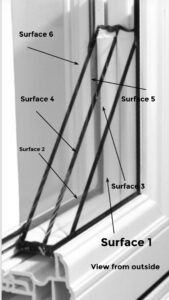
Explanation of Glazing Surfaces (Plain Language)
First (Exterior) Glass
- Surface 1: Faces outdoors. Usually clear or self-cleaning Neat+™ glass that collects less dirt.
- Surface 2: Faces the first chamber. Low-E coating here blocks heat before it builds inside.
Second (Middle) Glass
- Surface 3: Clear glass for balance.
- Surface 4: Clear glass to maintain light and clarity.
Third (Interior) Glass
- Surface 5: Can use Low-E 180, 272, or 366 depending on needs.
- Surface 6: Can use I-89 coating when reinforced properly with other Low-E coatings.
Correct balance across all six surfaces is critical for comfort.
Why Homes Get Too Hot in Summer
Overheating often comes from poor Low-E placement.
- Low-E coating placed on the wrong surface
- Overly aggressive coatings trapping heat inside
For Ontario, glass must block heat without stopping winter sun.
Why Homes Get Too Cold in Winter
Cold drafts usually point to gas or spacer failure.
- Argon gas escaping over time
- Low-quality spacer systems
- Pin-filled gas methods weakening seals
Once argon is gone, insulation performance drops fast.
Argon Gas Filling Technology: Why It Matters
In our opinion, chamber filling is the best way to fill argon gas.
- Gas is filled directly into the chamber
- No drilling holes
- No pins in the spacer
- Better long-term gas retention
This method protects seals and keeps performance stable for decades.
Spacer Material: A Hidden but Critical Part
The spacer holds glass together and keeps argon inside.
- Gas loss through weak spacers
- Seal failure over time
- Condensation between panes
Warm-edge composite spacers, such as Super Spacer, are essential.
Which Option Is Better? Our Ontario Recommendation
Ontario needs balance, not extremes.
- Low-E 180 on Surface 2
- Low-E 180 on Surface 5
This setup works because:
- Blocks excess summer heat
- Allows winter sun inside
- Maintains clear glass appearance
- Avoids over-darkening
Using Low-E 366 on multiple surfaces can block needed winter heat.
Noise Reduction: A Major Benefit
- Sound waves break across multiple chambers
- Less traffic and street noise
- Calmer indoor spaces
Ideal for homes near roads and busy areas.
Heat Control: Best Option for Summer
- Correct Low-E placement
- Balanced solar control
- Proper glass combinations
Smart balance beats the strongest coating.
Will I Get Condensation If I Choose Triple-Glaze Windows?
Interior condensation
- High indoor humidity
- Not a window failure
Condensation between panes
- Seal failure
- Argon gas loss
- Glass unit replacement needed
Properly built triple-glaze units stay clear for decades.
Best Option for Ontario (Collingwood to Toronto)
Ontario has cold winters and hot summers.
- Winter sun is important
- Summer heat must be controlled
- Durable sealing is critical
Balanced Low-E coatings, chamber-filled argon, and high-quality spacers perform best.
Why Choosing the Right Company Matters
Two windows can look the same but perform very differently.
The design, coatings, gas, and spacer all matter.
This is why homeowners looking for a company near me trust Trust Build Windows and Doors to design triple-glaze windows correctly for Ontario homes.
Final Thought
- Quieter rooms
- Better winter warmth
- Cooler summers
- Lower energy loss
Triple-glaze windows work best when every detail is done right.