
Blown-In, Spray Foam, or Batt?
Which Insulation Type Is Actually Right for Your Barrie Home
Three different insulation types. Three very different cost profiles, performance characteristics, and grant eligibility outcomes. Here is what Barrie homeowners need to know before choosing — broken down by zone, budget, and how much grant funding is on the line.
Why the Choice of Insulation Type Actually Matters in Barrie
When most Barrie homeowners research insulation upgrades, they focus on which zones to insulate and which grants to apply for. The type of insulation material often gets left to the contractor’s preference or whatever is cheapest on that week’s quote.
That is a mistake. The insulation type you choose affects R-value per inch, grant eligibility, moisture performance, long-term stability, and installation disruption — all of which matter more in Barrie’s freeze-thaw climate than in milder Ontario markets. The right choice varies meaningfully by zone, existing construction type, and your specific upgrade goals.
The Three Main Insulation Types
Blown-in insulation is the most common choice for attic upgrades in Barrie. Loose-fill cellulose or fibreglass is blown into the attic space using a machine, filling every gap and irregularity in the existing structure. A skilled crew can bring a typical Barrie attic from R-12 to R-60 in a single day.
R-value per inch: Cellulose: R-3.5 to R-3.8. Fibreglass: R-2.2 to R-2.7. Cellulose is generally preferred in Barrie’s climate for its cold-temperature performance and superior air-sealing characteristics.
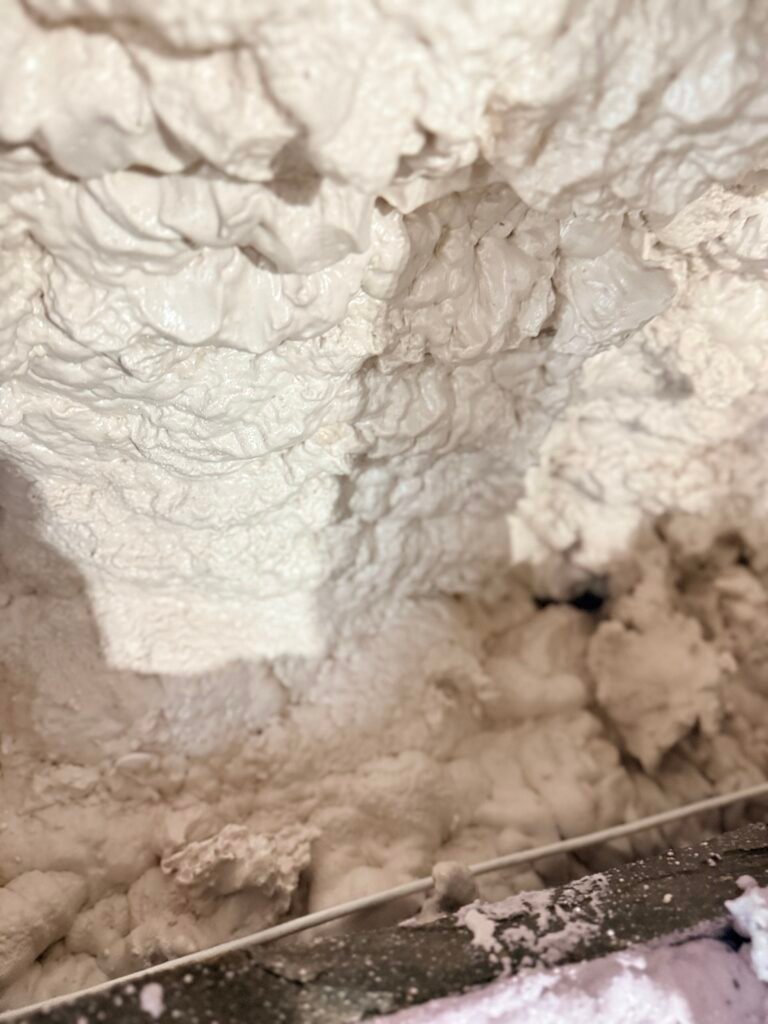
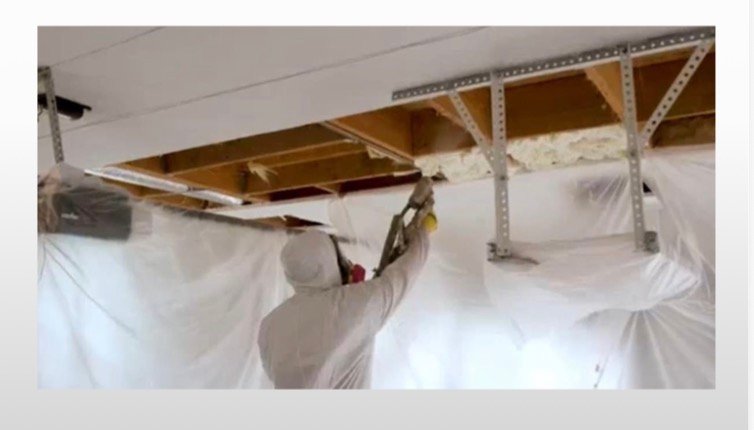
Spray polyurethane foam is applied as a liquid that expands and hardens on contact. Open-cell foam offers R-3.5 to R-3.8 per inch and excellent air sealing. Closed-cell foam provides R-6 to R-7 per inch and also functions as a vapour barrier — making it the highest R-value-per-inch product available for residential use in Canada.
Spray foam is the standard specification for basement rim joists in Barrie, where its combined insulation and air sealing properties in a tight, irregular space consistently outperform blown-in alternatives.
Batt insulation — the familiar pink or yellow fibreglass rolls — is the product most Barrie homeowners have seen in unfinished basements and between floor joists. Mineral wool (Rockwool) batts offer higher fire resistance and significantly better moisture performance than standard fibreglass, making them increasingly preferred for exposed basement wall applications.
Batts perform well in new construction where cavity dimensions are consistent and installation can be done with precision. In retrofit situations — existing attics, irregular stud bays, older framing with non-standard spacing — blown-in or spray foam typically outperforms batts because they fill gaps that batts leave around framing, wiring, and penetrations.
Which Type for Which Zone: Barrie Recommendations
Attic
Basement Rim Joists
Basement Interior Walls
Exterior Walls (Existing Home)
Cathedral Ceilings and Flat Roofs
How Insulation Type Affects Your Grant Recovery
The Canada Greener Homes Grant pays out based on achieving specific R-value targets in specific zones — not based on what material was used to get there. However, material choice directly affects whether you can reach those targets within the physical constraints of your home.
| Insulation Type | R-Value per Inch | Inches Needed for R-60 | Typical Grant Eligibility |
|---|---|---|---|
| Cellulose (blown-in) | R-3.5 to R-3.8 | 16–17 inches | Yes, if attic depth allows |
| Fibreglass (blown-in) | R-2.2 to R-2.7 | 22–27 inches | Yes, if attic depth allows |
| Closed-cell spray foam | R-6.0 to R-7.0 | 9–10 inches | Yes, in appropriate zones |
| Open-cell spray foam | R-3.5 to R-3.8 | 16–17 inches | Yes, in appropriate zones |
| Mineral wool batt | R-3.7 to R-4.2 | 14–16 inches | Yes, in appropriate zones |
| Fibreglass batt | R-3.0 to R-3.7 | 16–20 inches | Depends on installation quality |
The Bottom Line for Barrie Homeowners
Most Barrie homeowners pursuing grant-eligible insulation upgrades will end up with a combination: blown-in cellulose in the attic to reach R-60 at the lowest cost, and closed-cell spray foam in the rim joists and any other confined zones. This pairing is what most experienced Barrie insulation contractors default to for grant-eligible projects because it produces the best combination of performance, grant eligibility, and total project cost.
The choice that matters most is not actually between these product types — it is between contractors who understand grant project requirements and those who do not. A contractor who installs R-40 of fibreglass batt in an attic because it was what they had available is not providing the same service as one who installs blown-in cellulose to R-60 because that is what your audit report specified.
About Trust Build Windows and Doors
Trust Build Windows and Doors serves homeowners across Barrie, the GTA, Durham Region, and Kawartha Lakes. We come directly to your home with physical window and door samples, catalogues, and live demonstrations — including the visible and performance differences between double and triple-pane glass side by side, and real steel versus fiberglass door frame comparisons you can see and feel in your own space before committing to anything.
We offer 0% financing for 12 months on qualifying projects. No showroom visits. No pressure — ever.